

Two quotes for a camera tower can sit hundreds of dollars a week apart and still both be fair. One might be a single fixed camera on 4G for a fortnight. The other might be a twin-camera tower with 24/7 control room monitoring, Starlink and a 600 km delivery run. Same question, different jobs.
So how much does it cost to hire a site security camera? This guide breaks the price into the parts that set it: the unit, the hire term, monitoring, connectivity, and delivery distance. It also covers hire terms, how a camera compares with a guard, and where Siteguard delivers across Australia.
How much does it cost to hire a site security camera? There's no single national rate, because a hire quote is built from the unit, the hire term, monitoring, connectivity and delivery distance. As one public reference point, an AlburyCity council report in 2020 estimated trailer-mounted CCTV hire at about $20,000 per unit for six months, roughly $770 a week. Your quote will move with your site.
It depends on five things, and every one shows up on the quote. A site security camera hire cost is the weekly or monthly rate for the unit, plus whatever monitoring you add, the data connection, and the cost of getting the unit to your site and back. Change any one of those and the number moves.
Published prices are thin on the ground in this industry, and Siteguard doesn't list hire rates on its site either. A Twin Cam tower on a suburban build with good 4G and a crew on site by 6am is a different job from the same tower on a pipeline easement four hours from the nearest depot, watched around the clock.
Public figures do exist, though they date. In a 2020 report to AlburyCity councillors on mobile CCTV, council staff estimated trailer-mounted CCTV at about $20,000 per unit to hire for six months, against roughly $90,000 to $100,000 to buy. The same report put hiring or leasing a temporarily fixed camera at around $800 a month. Treat those as a reference point, not a price list: they're six years old, they're estimates, and the report doesn't say what each figure included.
What a reference point can't tell you is your number. The rest of this guide shows how each part of the quote is set, so you can read a quote line by line and know what's driving it. Councils weighing a trailer for public spaces should also read our guide to council CCTV trailer hire.
Most hire quotes for camera towers and trailers are built from the same handful of lines. Some suppliers bundle them into one weekly figure; others list each one. Ask for the breakdown either way, because a bundled rate makes it hard to compare two suppliers or to see what you'd save by dropping a feature.
| Line on the quote | How it's usually charged | What moves it |
|---|---|---|
| Unit hire | Per week or per month | Number and type of cameras, tower or trailer, extras such as lighting |
| Monitoring | Per week or month, sometimes per camera | Self-monitoring or a control room, armed hours, response level |
| Connectivity | Included, or a separate data or Starlink line | Mobile coverage at the exact spot the unit stands |
| Delivery and collection | Flat fee, or by distance | Distance from the nearest depot or dealer, site access |
| Installation and setup | Often a one-off fee | Number of units, zone and schedule setup, connectivity setup |
| Relocation | Per move | How often the work front moves, and who moves the unit |
| Add-ons | Per unit or per site | Number plate recognition, timelapse, AI reporting |
The first three lines carry most of the cost on a long hire. On a short one, delivery and setup can be a big share of the total, because they're charged once whether the unit stays a week or a year. That's why a two-week hire often costs more per week than a six-month one.
If you're pricing a whole security plan rather than just cameras, fencing, lighting and guards sit alongside these lines. Our guide to what construction site security costs covers the full budget, and how to secure a construction site explains how the layers fit together.
Pricing security for a build?
See how Siteguard covers construction sites from site establishment to handover, including theft, vandalism and after-hours access.
Siteguard for constructionThe unit is the base of every quote, and the gap between units is real. More cameras, wider coverage and remote control all add to the weekly hire rate. The trick is to pay for the coverage each part of the site needs, not to put the biggest unit everywhere.
Siteguard's solar camera towers come in four configurations, and each suits a different job:
Then there's the choice between a tower and a trailer. Siteguard's CCTV surveillance trailers are road-certified and self-contained, with options including solar power, Starlink, lighting and custom camera setups, plus GPS and a steel chassis. Trailers suit sites that move often, such as road works and short-term compounds, where you'd rather tow than lift. Towers suit a perimeter that will stay put for a while. Our comparison of CCTV tower vs CCTV trailer goes through the trade-offs.
The cheapest way to cut the unit line is to get the number of units right. A Single Cam on the gate and a Twin Cam on the back fence can do more than two big towers placed badly. See how many security cameras a construction site needs for a way to map it out, and how solar CCTV towers and trailers work for what's inside each unit.
Hire length changes the rate as much as the unit does. Short-term hire spreads delivery and setup across fewer weeks, so the effective weekly figure is higher. Longer hires usually attract a lower rate per week, because the unit isn't sitting in a yard between jobs.
Siteguard's enquiry form takes hires from less than a week through 1 to 2 weeks, 2 to 4 weeks and 1 to 3 months, up to 6 to 12 months. That covers most jobs:
If you're searching for a site security camera hire price per week, ask any supplier for the weekly rate at two or three hire lengths. The difference tells you where the break points are. With the Christmas shutdown close, it's also worth booking early: our guide to securing your site over the Christmas shutdown covers what to set up before the gates close.
At some point, hiring stops making sense. The Albury figures show why: about $20,000 for six months of trailer hire against $90,000 to $100,000 to buy. On those numbers, buying only pulls ahead after about two and a quarter to two and a half years of continuous hire, before you count maintenance, transport and monitoring. If you have a run of projects back to back, the maths can change. Our hire or buy cost comparison works through it, and Siteguard also sells solar CCTV towers and trailers outright.
A camera on its own records. Someone still has to act on what it sees. Monitoring is the line on the quote that decides who that is, and it's often the second-biggest cost after the unit.
At the low-cost end is self-monitoring. Alerts go to your phone, and you check the live view and recordings through Siteguard Foreman, the browser-based dashboard that holds every camera, alert and recording across your sites. It suits daytime checks and small sites, if somebody answers a 2am alert.
At the other end is a staffed control room. With Siteguard's 24/7 control room monitoring, an Australian-based operator verifies every alarm, issues audio warnings, sets off the siren and escalates to the relevant authorities when required. That cover runs on weekends and public holidays too. You pay more than for alerts alone, and you get a person making the call.
The cost of monitoring moves with the hours you arm, the number of cameras and the response you want. We cover the numbers in what site camera monitoring costs per month, and the full response chain in what happens when monitored cameras detect an intruder.
Match the tower to the job
Single Cam for a gate, Twin Cam for a perimeter, Pan & Zoom for open ground. Compare the four tower configurations before you ask for a quote.
See the tower rangeA tower can only send an alert or a live view if it can get a signal out. On sites with solid mobile coverage, 4G does the job and adds little to the quote. On sites without it, you need satellite, and that's a separate line.
The Siteguard Starlink Tower pairs surveillance with satellite connectivity for remote locations without 3G or 4G coverage. It's built on heavy-duty steel with a forklift and lifting hook, a vandal-resistant base, and solar panel mounting points for off-grid operation. Siteguard's team handles the full Starlink setup, so the connection works from day one.
Starlink adds cost, and it adds a bigger power budget on a solar unit. Don't pay for it if the site doesn't need it. Test the signal where the unit will actually stand, not at the site office or the gate. Our guide to choosing 4G or Starlink for site cameras includes a quick test, and remote site security covers sites with no power, internet or people at all.
Getting the unit to your site and setting it up is the line that varies most by postcode. A tower going 20 minutes from a dealer's yard costs less to deliver than one going 600 km up the highway. Remote and regional sites also take longer to service if something needs attention mid-hire.
Siteguard runs nationally through a network of local dealers and installers in every state and territory, so a unit for a regional job doesn't always have to start its trip from a capital city. Some hire companies also carry Siteguard units in their own hire fleets, which can put a unit closer to your site.
Setup is more than standing the unit up. Someone has to place the towers where intruders come in, draw detection zones, set armed hours to the site's real knock-off, and load the call list. Ask whether that's in the installation fee, and who changes the zones when the site changes.
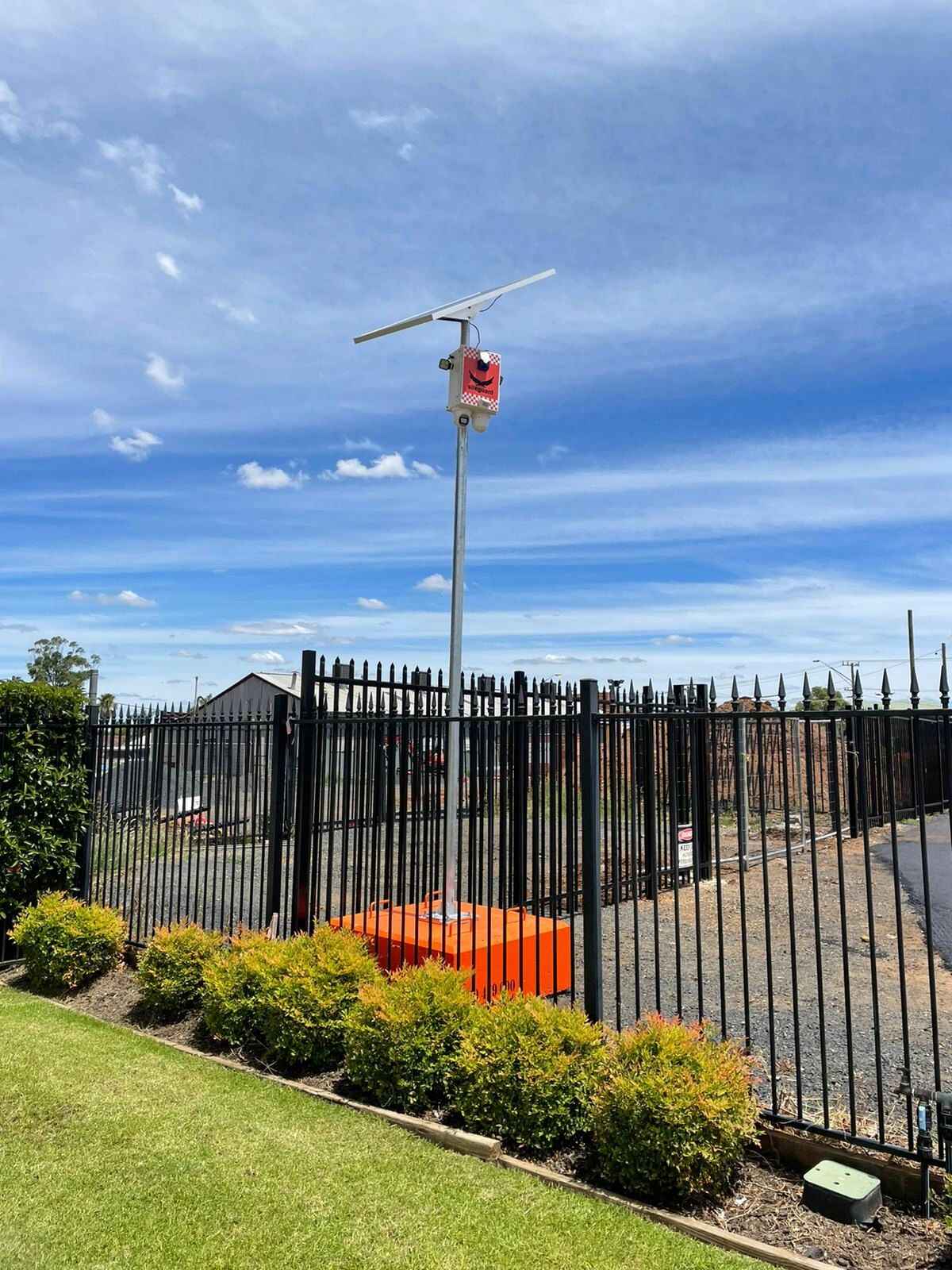
Relocation is the cost people forget. On a linear job or a staged build, the camera needs to move with the work front. Trailers tow to the next position, and the Starlink Tower has a forklift and lifting hook for moving it. Ask how each move is charged, and read moving and adding site cameras as your project grows before you plan the stages.
Before you accept a quote, ask what the delivery figure covers: delivery only, or delivery, setup and collection. A low hire rate with separate charges for setup, each relocation and collection can cost more over a three-month job than a higher all-in rate.
Most people pricing camera hire are really asking whether it's cheaper than a security guard. For overnight and weekend cover, the gap is wide, because guards are paid by the hour with penalty rates on weekends and public holidays.
Under the Fair Work Security Services Industry Award pay guide, a full-time level 1 security officer's minimum rate from 1 July 2026 is $28.42 an hour for ordinary hours, $42.63 on a Saturday, $56.84 on a Sunday and $71.05 on a public holiday. Two 12-hour weekend shifts at those flat rates come to about $1,190 in award wages alone, before overtime, allowances, and the security company's own costs and margin.
Set that against the 2020 council estimate of roughly $770 a week for a trailer that covers every night of the week. The figures aren't like for like, and your quotes will differ. The direction is clear, though: a camera is a fixed weekly cost for round-the-clock cover, while a guard's cost climbs with every hour on site.

"Last Christmas we had 21 break-ins into our construction site. We installed a Siteguard system on site and this Christmas we only had 1 attempted break-in. It has even saved us the cost of paying for security guards." Kevin, Senior PM, Hines Constructions Pty Ltd
Guards still have jobs cameras can't do: meeting a 5am delivery, checking a door is locked, or meeting a contract clause that calls for a person on site. Many sites run monitored cameras as the baseline and book guards for specific risks. See security cameras vs security guards for the side-by-side and what a construction site security guard costs for guard pricing in detail.
The weekly rate is only part of what you're agreeing to. Read the hire terms with the same care as the price, because the fine print decides what you pay when something changes. Get answers to these in writing:
Surveillance and privacy rules also differ between states and territories, and recording audio is more restricted than video in several of them. Signage saying the site is under camera surveillance is common practice. Check the rules for the state your site is in before the unit goes live.
Siteguard is deployed and supported across every Australian state and territory, from remote sites to city projects. Its branches and dealer network covers New South Wales, Victoria, Queensland, Western Australia, South Australia, Tasmania, the Northern Territory and the ACT. In New South Wales that coverage runs from the heart of Sydney to the Central West.
Regional cost drivers change from place to place: distance from the nearest yard, mobile coverage at the edge of town, the projects running in the area, and the time of year. Our local guides cover delivery, project types and typical hire terms for each area:
Not on the list? Siteguard still covers your area. The full range of hire options sits on the site security camera hire page, and the team can tell you which dealer or installer is closest to your postcode.
A quote is only as good as what you tell the supplier. Vague details get a padded number or a lowball that grows later. Have these ready before you call or fill in a form, and you'll get a like-for-like quote you can compare:
Those are the same details Siteguard's enquiry form asks for. Tell the team about your site and they'll recommend the right system for your industry, environment and budget. If you also need vehicle logs at the gate, ask about number plate recognition cameras in the same quote, so the add-on is priced alongside the towers rather than as a separate job.
There's no single rate. The quote depends on the unit, the hire term, monitoring, connectivity and delivery distance. As a public reference point, an AlburyCity council report in 2020 estimated trailer-mounted CCTV hire at about $20,000 per unit for six months, which is roughly $770 a week.
For overnight and weekend cover, cameras usually cost less. Under the Security Services Industry Award, a level 1 officer's minimum rate from 1 July 2026 is $42.63 an hour on a Saturday and $56.84 on a Sunday, before the security company's costs. A camera hire is a fixed weekly cost for round-the-clock cover.
It varies by supplier, so check the hire terms. Siteguard's enquiry form takes hires from less than a week up to 6 to 12 months. Short hires cost more per week because delivery and setup are spread over fewer weeks.
Not always. Some quotes cover the unit and alerts to your phone, while others add a control room that verifies alarms and responds. Siteguard's 24/7 control room monitoring is run by an Australian-based team and covers weekends and public holidays.
Often, yes. Delivery, setup, relocation and collection can be separate lines or included in the hire rate. Ask what the delivery figure covers, and how each move is charged if the work front changes.
Yes. The Siteguard Starlink Tower pairs surveillance with satellite connectivity for remote locations without 3G or 4G coverage, and the solar towers run without mains power. Starlink adds to the quote, so test the signal where the unit will stand first.