.svg)
.jpg)
A remote site has three problems a city job never sees at once: no mains power, no reliable internet, and nobody within an hour's drive once the crew leaves. Fixed CCTV needs the first two, and a guard is the third you're paying for. Remote site security works when you solve all three together, because a camera that can't stay powered, can't send an alert, or alerts nobody hasn't protected anything.
This guide covers each layer in turn: off-grid solar power, getting footage off site over 4G or Starlink, deterrence that works with nobody around, and monitoring that turns an alert into a response. Then it looks at how the setup changes across civil, mining and renewables projects, and finishes with a deployment checklist.
Remote site security means protecting a site that has no mains power, no reliable mobile coverage and no people on it after hours. The standard setup is a solar-powered camera tower or trailer, connected over 4G where the signal is genuinely there and Starlink where it isn't, with sirens and strobes to deter, and a monitored control room to verify alerts and escalate to authorities.
A site is remote for security purposes when it can't lean on the infrastructure a suburban job takes for granted. That might be a mine exploration lease three hours from town, a pipeline or road corridor running through farmland, or a solar farm build spread across hundreds of hectares. Distance is part of it. The bigger issue is what's missing when you get there.
Three gaps define it. There's no grid power to run cameras, lights or a recorder. There's patchy or no mobile coverage, so footage can't get off site. And there are no people after knock-off: no neighbours to notice a strange ute, no passing traffic, and police or a patrol that may be a long drive away.
Each gap knocks out a different part of a normal security plan. Remote site security is the practice of replacing every one of them with something that works without the town: solar for power, satellite or 4G for connectivity, and a remote control room for the eyes and response.
A fixed CCTV system assumes a building to mount on, a power point to plug into and an internet connection to stream over. On a greenfield site in week one, none of those exist. Trenching power to a camera pole costs time and money, and the site layout will change before the job ends anyway. If your site has no mains power and patchy 4G, a fixed CCTV quote is the wrong quote.
Coverage is the other trap. The Federal Communications Minister's office has described around 70 per cent of Australia's land mass as having no mobile coverage. Plenty of mining, civil and renewables work happens in exactly that 70 per cent. A camera without a link records, but nobody hears about an intrusion until someone checks the footage, often days later.
And the losses are real. A 2021 survey by the University of New England's Centre for Rural Criminology found 81% of NSW farmers had experienced crime on their properties, with reported fuel theft up 96% in NSW police data for 2021–22. Remote construction and mining sites carry the same targets: diesel, copper, tools and plant, left in places where a thief can work undisturbed for hours.
Running a mine, camp or exploration lease?
See the setup Siteguard recommends for mining: long-range pan and zoom coverage, Starlink, Foreman and a 24/7 control room.
Siteguard for miningThe answer on almost every remote job is a solar security camera system: panels, a battery, cameras and a modem on one engineered base. The panel charges the battery by day and the battery runs everything overnight, so the unit lives on a daily energy budget. Our guide to how solar CCTV towers and trailers work walks through each component in detail.
For remote sites, the budget is tighter than it looks. A Starlink dish draws more than a 4G modem, sirens and strobes add load every time they fire, and winter days are short. Ask any supplier for the days of autonomy for your exact configuration in your site's worst month, not a best-case figure.
Siteguard's solar camera towers are built off-grid ready, with solar power and satellite connectivity for mining and remote locations. The Starlink Tower adds solar panel mounting points as part of its engineered structure, so the panels aren't an afterthought bolted to the side.

If you're starting from a bare paddock, our step-by-step guide on how to secure a remote site with no power covers setup in order. And if you're weighing a small standalone camera against a full tower, we compare the off-grid security camera options and where each makes sense.
Point the panels north and keep them clear of shade from site sheds, stockpiles and plant. On dusty mine and quarry sites, add panel cleaning to the weekly walk-around, because grime cuts charging long before anyone notices.
Power keeps the cameras running. Connectivity decides whether anyone finds out what they saw. There are three ways to handle it, and the right one depends on what the signal is like where the unit actually stands, not in the site office or the car park.
| Option | Best for | Trade-off |
|---|---|---|
| 4G modem | Sites with a genuinely strong signal at the camera position | Signal can drop at the far fence or as the site changes; no live alerts when it does |
| Starlink satellite | Sites with weak or no mobile coverage | Bigger power draw, so the solar and battery must be sized for it |
| Record on board only | Low-risk areas where evidence after the fact is enough | No live alerts and no intervention; you find out when you check the footage |
Siteguard's Starlink connectivity integrates with all Siteguard camera systems and the Siteguard Foreman dashboard, supporting live video streaming, remote camera access and real-time alerts where 3G and 4G don't reach. The team handles the full setup, so the site is connected from day one.
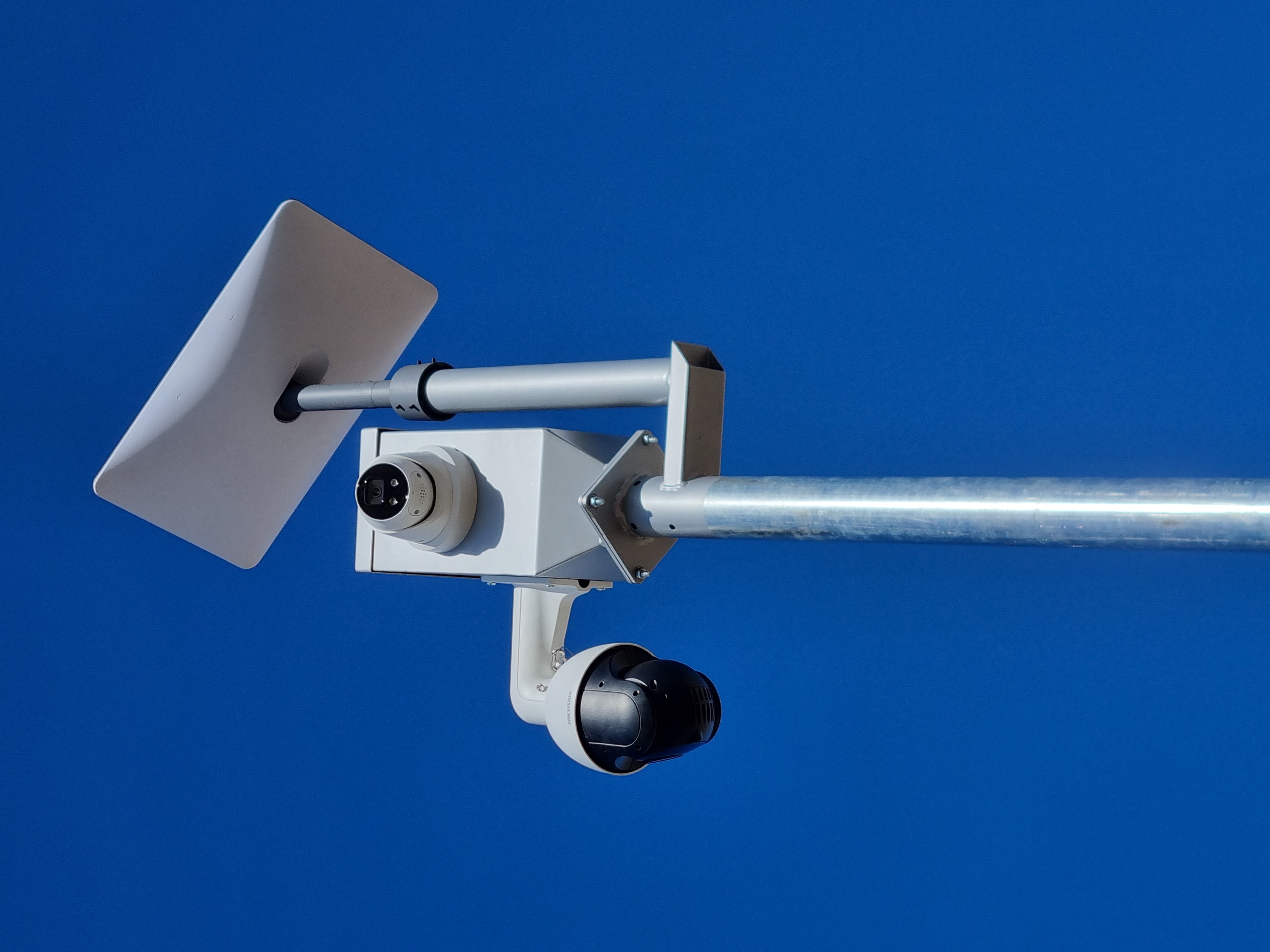
Satellite-to-phone services are coming, but the government's early focus is emergency contact with triple zero, with basic data to follow later. That's a long way from streaming live video off a camera tower. Don't plan site security around them yet. For the detail on choosing, read 4G or Starlink for site cameras, which includes a quick test for whether your site needs satellite. If you've already found the dead zones, our piece on security cameras where there's no mobile coverage covers boosters, satellite and local recording.
No power. No signal. No problem.
The Siteguard Starlink Tower combines solar-ready surveillance with satellite connectivity for sites without 3G or 4G coverage.
See the Starlink TowerOn a remote site, stopping an intruder at the boundary matters more than identifying them afterwards. Police may be hours away, and fuel or cable is gone in minutes. That makes active deterrence the most valuable thing a camera tower does. A tower with a siren and strobe on the site boundary gives a would-be thief a reason to leave before they reach the fuel tank.
Siteguard's Twin Cam tower carries a siren and strobe with smart alerts, and the Single Cam has siren and audio. A highly visible tower on the access track does some of the work before anything fires, because it tells people the site is watched.
Some areas suit the opposite approach. Siteguard Ghost Cams use low-light and thermal imaging to capture clear footage in near-total darkness without visible flash or warning, with a covert low-profile housing. They're solar powered and send instant motion alerts, which suits fuel storage, plant yards and camps where you want evidence of who keeps coming back.
Deterrence only works if it fires at the right moment. Detection software should be tuned for the site, and someone should be able to talk to the intruder through the speaker, which brings in the next layer.
An alert on your phone at 2am is only useful if you're awake, can see what triggered it, and know what to do next. On a remote site, the site manager is often the person least able to act. They're asleep in town, and the nearest patrol is a long drive away. That's why monitored cameras are the backbone of remote site security, not an optional extra.
Siteguard's Control Room Monitoring puts an Australian-based team on your cameras 24 hours a day, including weekends and public holidays. Every alarm is verified by a real operator before action is taken, so false alarms don't turn into call-outs. When it's real, operators issue audio warnings and activate the siren, and escalate to the relevant authorities when required.
That human step is what makes a remote response plan workable. A verified alarm with footage gives police a reason to prioritise the job. It also gives you an incident record for insurance, instead of a vague report that something went missing over the weekend. We cover the whole sequence, from detection to escalation, in what happens when a camera detects an intruder.
Most remote sites have one or two vehicle entries and a lot of open boundary. Thieves need a vehicle to move fuel, cable drums or plant, so the access track is where you learn the most. Watching the gate tells you who came in, when, and whether they belonged there.
Siteguard's number plate recognition cameras read and time-stamp every vehicle entering or leaving, with a searchable vehicle database for audits, disputes and evidence. They're solar powered with night vision and built-in lighting, need no cabling or mains power, and send an instant alert when a vehicle arrives on site.
On mine sites, those logs also support the access control and record-keeping that mining operations demand. Portals and tunnel entries raise their own coverage and connectivity questions, covered in tunnel monitoring cameras in mining.
The layers stay the same across industries. What changes is the shape of the site, what gets stolen, and how often the coverage has to move.
| Site type | Main risks | Setup that suits it |
|---|---|---|
| Mine and exploration sites | Vast areas, few people, fuel and equipment theft, dust, heat and wind | Pan and zoom towers, Starlink, ANPR at gates, control room monitoring |
| Civil and linear projects | No early infrastructure, many access points, changing layouts | Pan & Zoom 360° towers, trailers that move with work fronts, Starlink |
| Solar, wind and battery builds | Long open perimeters, copper and component theft, spread-out laydowns | Relocatable towers at laydowns and gates, Starlink where 4G fails |
Mining sites combine large, remote operational areas with strict access and compliance needs, and conditions that damage standard gear. For mine sites, Siteguard recommends a Pan & Zoom Twin Cam tower with Starlink connectivity, Siteguard Foreman and control room monitoring of critical zones. Our guide to mining site security cameras covers dust, heat, gate ANPR and hire versus buy over a long mine life.
Exploration is different again: short campaigns, small crews and fuel left in the open. Relocatable solar units move with the program, as covered in security for exploration camps.
Roads, pipelines, rail and utility projects start with no power or internet on site and keep changing for months or years. Siteguard's recommended civil and infrastructure setup pairs a Pan & Zoom 360° tower for long-range visibility with Starlink, Foreman and AI Reports. Linear jobs add moving work fronts and laydown yards strung along the corridor, which we cover in transmission line construction security. For council, government and depot sites, see our guide to infrastructure project site security.
Renewables builds are big, flat and open, with high-value copper cable, components and plant spread over a long perimeter. Fencing a solar farm doesn't stop someone cutting through at the far corner, so coverage goes where the value sits: laydown yards, cable drum storage, inverter areas and gates. We go deeper in solar farm construction security, and wind and battery projects get their own treatment in renewable energy project site security.
Once power, connectivity and response are settled, the hardware question is about coverage and movement. Siteguard's tower range covers four configurations:
The format matters as much as the cameras. Siteguard's solar CCTV trailers are road-certified and self-contained, with options including solar power, Starlink, lighting and custom camera setups, plus GPS, UHF radio and a weather station. They suit linear projects and exploration programs that move every few weeks. A tower suits a fixed laydown or gate for the life of the job.
The Starlink Tower is built for the harshest end of the scale: heavy-duty steel construction, weather protection, a vandal-resistant base, and a forklift and lifting hook for transport. It's fully engineered and wind rated, which matters for a mast carrying cameras and a dish on an exposed ridge.
The failures on remote jobs are rarely about the camera itself. They come from assumptions that hold in town and fall apart a few hundred kilometres out.
Every one of these is cheaper to fix in planning than after a weekend of losses. The checklist below turns them into questions to settle before the first unit arrives.
Remote deployments go wrong in predictable ways. Most of them are fixed by doing the planning before the truck leaves the depot. Work through this list with your security provider:
The same thinking applies to any construction job. If your remote project is also a build site, our guide on how to secure a construction site covers fencing, lighting, storage and guards alongside cameras.
Before signing off on a quote, ask what happens when the battery runs low. Find out which features switch off first, and whether the control room is told. On a remote site, you want to know about a flat unit before a thief does.
Remote site security is protecting a site that has no mains power, poor or no mobile coverage and no one on site after hours. It replaces each missing piece: solar power for the cameras, 4G or Starlink to get footage and alerts off site, and a monitored control room to verify alarms and respond.
Yes. Solar-powered camera towers and trailers run off-grid with no mains power or cabling, and they record on board. To get live view and instant alerts, they need a connection: 4G where the signal is strong, or Starlink satellite where mobile coverage doesn't reach.
Not always. 4G works well where the signal is genuinely strong at the camera position, and it uses less power. Starlink is the better choice where coverage is weak or missing, but the solar and battery need to be sized for the dish's extra power draw.
With control room monitoring, an operator verifies the alarm, issues audio warnings and activates the siren, then escalates to the relevant authorities if required. Without monitoring, the alert goes to whoever is on the notification list, which on a remote job is often someone hours away.
Yes. Solar CCTV trailers are road-certified and self-contained, so they can be towed to the next work front, and towers can be relocated as laydowns and gates change. On linear projects like pipelines, roads and transmission lines, plan the moves into the schedule so coverage follows the work.
Yes. Siteguard operates nationally, including Western Australia and the Northern Territory, through a network of local dealers and installers, with systems backed by Australian support and a 24/7 control room.