.svg)

A construction site is at its most exposed the minute the last ute leaves. Tools sit in sheds, cable sits on drums, plant sits in the laydown area, and the fence that looked solid at 3pm has a gap where a trade moved a panel to get a delivery in. Working out how to secure a construction site is less about buying one big fix and more about stacking a few security layers so each one covers what the others miss.
This guide covers the legal duty, the threats Australian sites face, the six layers (fencing, lighting, secure storage, cameras, monitoring and guards), what each costs, and a stage-by-stage plan from site establishment to handover.
Here's how to secure a construction site: assess the risk first, then layer your controls. Fence the perimeter with lockable gates, light the key areas, lock tools and materials away, cover gates, laydown areas and sheds with cameras, and make sure someone acts on alerts after hours through monitoring or guards. Under the WHS Regulations, securing the site from unauthorised access is a legal duty.
Site security isn't only about protecting your margin. Under regulation 298 of the WHS Regulations, the person with management or control of a workplace where construction work happens must ensure, so far as is reasonably practicable, that the workplace is secured from unauthorised access. That's how WorkSafe WA explains the duty under its WHS (General) Regulations 2022, and the HIA sets out the same regulation for South Australian builders.
In NSW, SafeWork NSW's site security checklist sets out what that looks like on the ground: a fence with no gaps or missing panels, gates with a chain and lock, signage visible from outside the site with the principal contractor's name and a 24/7 contact number, mobile plant parked with the keys removed, and gas, water and power isolated at the source. SafeWork NSW inspectors also check sites over the Christmas break, and an unsecured site can attract an improvement or prohibition notice, or an on-the-spot fine of $2,700 for a business.
The regulation asks you to weigh the health and safety risks of someone getting in, how likely that is (a site next to a school, park or shops is a different risk to a paddock), and how you'll isolate hazards if you can't keep people out. Open excavations, partly built structures and unattended scaffolds are the usual concerns. A kid climbing a scaffold on a Sunday is a safety incident first and a security failure second.
Wherever you build, plan site security before works start and check the guidance from your state regulator.
Most losses fall into a handful of patterns. Knowing which ones apply to your job tells you where to spend.
There's also a cost that doesn't show on a police report: disputed incidents. Without footage, a damaged slab, a missing delivery or a contractor's claim turns into a slow argument. Most disputes come down to a time: when the truck arrived, or when the panel was moved. With Siteguard's Ask Foreman, you get a timestamped report of vehicle and people movements, with images and summaries, ready for the authorities. Evidence is part of security too. For the figures behind all this, see construction site theft in Australia by the numbers.
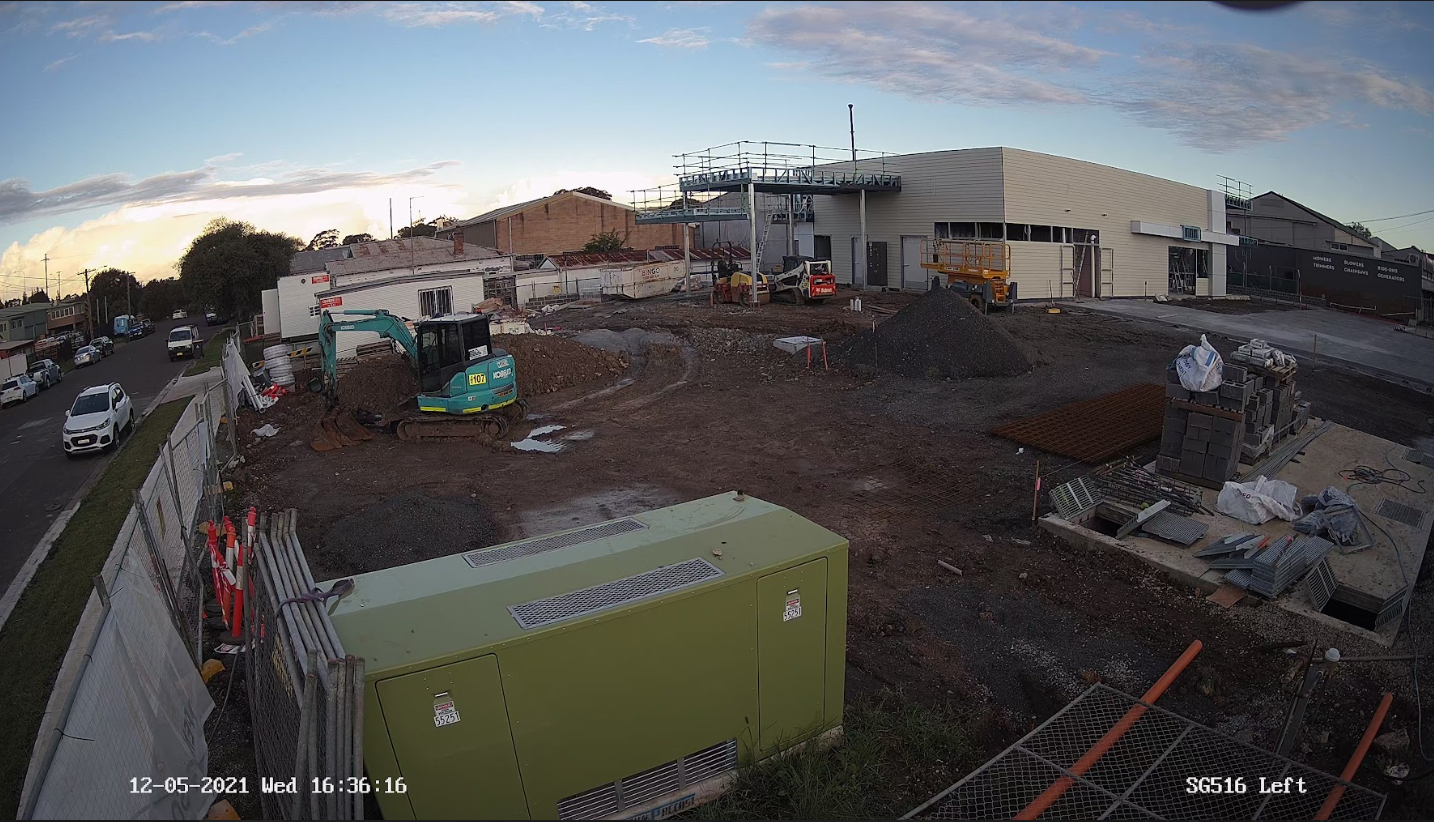
Risk isn't spread evenly across a project. It peaks when the site is empty and stocked at the same time.
Nights and weekends are the obvious window. Most sites sit unattended for over half the week once you add up evenings, Saturdays after knock-off, and Sundays.
The Christmas shutdown is the big one. A site can sit locked and empty for two to three weeks with materials delivered for the January restart. Master Builders NSW publishes a holiday shutdown checklist for exactly this period. Our guide to securing your site over the Christmas shutdown walks through it.
Early works and fit-out carry their own risks. During establishment the perimeter is still going up and nothing is lockable yet. During fit-out, high-value cable, fixtures and appliances arrive in bulk and sit inside a building that's easy to get into. Plan for both before they arrive.
See how Siteguard covers a live build
Tools, plant and fuel left overnight, open boundaries and trades changing weekly. Here's the setup Siteguard recommends for construction sites.
Siteguard for constructionThe fence is your first layer and your legal baseline. It should be hard to climb, crawl under or push over, stand up to wind, and have no weak joins or gaps. Gates need to be as secure as the fence they sit in, with proper locks and chains, and someone has to close them every day. The HIA guidance makes all of these points.
Hoarding does the same job with solid panels, which also hides what's inside. That matters more than it sounds: a thief who can't see the plant from the footpath has less reason to try.
A fence's limits are just as important. It slows people down but doesn't tell anyone they've arrived. Trades open panels for deliveries and forget to close them. Plant parked against the fence becomes a ladder. Gates are the point where a fence is most often defeated, so they need their own tools. A camera on the gate captures the most useful footage on site, and Siteguard's number plate recognition cameras log and time-stamp every vehicle in and out in a searchable number plate log, so you can check exactly which truck came through and when. That's why fencing works best paired with cameras, which we cover in temporary fencing and security cameras working together.
Good lighting does two jobs: it makes a site less attractive to anyone looking for cover, and it gives cameras something to see. Motion-sensor lights over gates, sheds and laydown areas are on the Master Builders NSW shutdown checklist for that reason.
Lighting has gaps of its own. Mains-powered floodlights may not be an option before power is connected, and a light that stays on all night becomes part of the scenery. Lights that switch on when something moves are harder to ignore.
Cameras built for darkness fill the rest. Siteguard's thermal night vision Ghost Cams use low-light and thermal imaging to capture clear footage in near-total darkness, with built-in deterrent lighting and optional strobes. They're also solar powered, so they work where there's no power to run floodlights.
The most valuable gear on site usually ends up in one place, so harden that place. The Master Builders NSW checklist covers the basics:
Keep an inventory of what's left on site, especially before a long break. If something goes missing you'll know what, and your insurer will ask.
Camera hardware needs protecting too. A tower that can be climbed or opened is a target in itself. Siteguard's anti-vandal Shark Cages are a steel enclosure built into the tower with a lockable panel. They fit every Siteguard camera system and give you somewhere to secure tools and valuables inside the tower itself.
Cameras are where a site goes from "hard to get into" to "someone knows when you do". They detect, deter and record, and on a construction site they do it without the trenching and cabling a fixed CCTV system needs.
That's the main reason mobile solar camera towers suit construction sites so well. Siteguard offers four tower configurations on one platform:
Where a site keeps moving, a road-certified CCTV trailer tows to the next stage, and where there's no 4G coverage, Starlink camera towers provide the connection. For a deeper look at the hardware, see how solar CCTV towers and trailers work.
.webp)
Placement matters more than camera count. Cover the gates, laydown areas, sheds and containers, parked plant and fuel first, then the fence lines between them. If you're hiring rather than buying, our site security camera hire page explains how hire works.
Surveillance and privacy rules differ between states and territories, and recording audio is more restricted than video in several of them. Signage telling people the site is under camera surveillance is common practice. Check the rules for the state your site is in.
Cameras record. Monitoring responds.
See how Siteguard's Australian-based operators verify alarms, warn intruders off and call in the authorities, 24 hours a day. Our alerting system also texts you a clear description of each event with a screenshot, so you know in seconds what's happening.
How monitoring worksA camera that only records gives you good footage of the thing that already happened. The layer that stops it happening is someone acting on the alert while the intruder is still at the gate.
There are two ways to do that. Self-monitoring sends alerts to your phone. With Siteguard Foreman you can see every camera across every site in one browser-based dashboard, review footage without downloading it, and set what happens when an event triggers: siren, strobe, push notification or all three. With Ask Foreman, you can ask your site anything. Type "What happened on site last night?" and Foreman returns any alerts or intrusions you should know about. That works well for small sites and for checking what happened overnight.
Where self-monitoring usually breaks down is alert overload. A poorly set-up camera that pings for every swaying branch, passing car and trade working late soon gets muted, and then the alert that matters gets missed too. The fix is in the setup. Siteguard's tech support team tightens detection zones, sets alert schedules around your working hours, and uses person and vehicle detection rather than plain motion detection, so the alerts that reach your phone are worth opening. Even well-tuned alerts need someone to answer them, though, and at 2am on a Saturday that's rarely you.
Professional monitoring puts trained people on the alerts. With 24/7 control room monitoring, Siteguard's Australian-based operators verify every alarm before acting, so a kangaroo crossing the laydown area doesn't turn into a false callout. When it's a real intruder they issue audio warnings and set off the siren, and escalate to the authorities when it's needed. That runs on weekends and public holidays too, which is when most sites are empty.
The difference shows up in results. One Siteguard client put it this way:
"Last Christmas we had 21 break-ins into our construction site. We installed a Siteguard system on site and this Christmas we only had 1 attempted break-in. It has even saved us the cost of paying for security guards." Kevin, Senior PM, Hines Constructions Pty Ltd
For the full picture of what happens between detection and response, see monitored site security explained.
Guards do things cameras can't. A guard can physically check a door, stop a vehicle at the gate during work hours, and stand at an open area while a fence is repaired. On high-risk sites, at handover, or when a fence has been breached, a person on site is sometimes the right call.
Guards are also the most expensive layer per hour, and the timing works against you. The Security Services Industry Award sets a minimum rate of $28.42 an hour for a full-time Level 1 security officer from 1 July 2026. Sundays pay 200% of that and public holidays 250%. For a casual guard the public holiday rate is 275%, which is at least $78.16 an hour in wages alone. That's before the security company adds super, insurance and its own margin, so the rate you're quoted will be higher.
Those penalty rates land on nights, weekends and the Christmas shutdown, which is exactly when sites need cover. That's why many builders use cameras and monitoring as the baseline and book guards or random patrols for specific risks. The Master Builders NSW checklist suggests a guard "only if required" for the shutdown. Monitoring and guards aren't either/or. Monitored cameras can tell you when a guard actually needs to attend.
Prices depend on site size, duration and location, so ask for quotes on your own site. The figures below are indicative published rates as of October 2026, excluding GST. Where suppliers don't publish rates, the table shows how that layer is usually priced.
| Layer | Indicative cost (ex GST) | What it does well | Where it falls short | Use it when |
|---|---|---|---|---|
| Fencing and hoarding | Hired per panel or per metre, plus delivery and install. Most suppliers quote per job | Legal baseline, slows entry | Doesn't detect anyone | Every site, from day one |
| Lighting | Per light or light tower, bought or hired. Hire is usually quoted per job | Removes cover, helps cameras | Needs power, easy to ignore if always on | Gates, sheds, laydown |
| Secure storage | 20ft container hire from about $90 to $120 a month on a 3+ month hire, plus delivery | Protects the highest-value gear | Only covers what's locked away | Tools, cable, electronics |
| Camera towers | Published hire rates from about $100 to $240 a week per unit. Siteguard towers from [$X] a week | Detects, deters, records, moves with the site | Needs someone to act on alerts | Sites left unattended |
| Monitoring | An ongoing fee while the site is covered, quoted per site | Real-time response after hours | No one on site physically | Nights, weekends, shutdowns |
| Guards | Award wages from $28.42 an hour (weekday) to $78.16+ (casual, public holiday), before the security company's margin | Physical presence and checks | Highest cost, one place at a time | Specific high-risk periods |
The pattern for most sites: fencing and storage from day one, cameras covering the gates and high-value areas, monitoring for after hours, and guards held back for specific risks. For whole-of-project budgets, see what construction site security costs, and for camera hire pricing, our guide to site security camera hire costs across Australia.
Most break-ins don't beat a good system. They walk through a gap someone left open. These are the ones that come up again and again:
Each of these is cheap to fix compared with the loss, and most need a process rather than more equipment.
Security needs change as the build does. A plan by stage keeps the layers matched to the risk.
Before work starts, get the perimeter, signage and gates in, decide who gets alerts, and put cameras on the gates and the first laydown area. The HIA suggests doing the security risk assessment before the contract is signed, so security is priced in rather than added later as a variation. Our guide on site establishment security requirements covers what contracts, councils and insurers expect.
Move cameras as the site changes. A tower that covered the slab in month one may be looking at an empty corner by month four. Watch the gate during work hours, when deliveries and trades come and go, and check the fence at knock-off every day.
This is when monitoring matters most. Set detection zones on the areas nobody should be in at night, and make sure every alert reaches a person who will act on it.
Before a long break, run the shutdown checklist: inventory, plant away from fences, containers blocked, sheds locked, cameras tested and monitoring confirmed for the full period. When you come back, ask Foreman what happened over the break, then walk the site again.
Fit-out and handover put the most expensive finishes and appliances on site just as the fence comes down. Keep cameras until the keys change hands. A visual record from construction timelapse also helps settle any defect disputes that come up later.
For a printable version, use our construction site security checklist. Remote or off-grid jobs add their own problems, covered in remote site security.
Yes. Regulation 298 of the WHS Regulations requires the person with management or control of a construction workplace to ensure, so far as is reasonably practicable, that it is secured from unauthorised access. Victoria has its own OHS laws, so check your state regulator's guidance.
Close and lock the gates, check the fence at knock-off, lock tools and electronics away, and switch on cameras with intruder alerts. The step most sites miss is response: monitoring means a person sees the alert and acts on it while the intruder is still on site.
They do different jobs. Monitored cameras cover the whole site around the clock at a lower cost than guards on night and weekend penalty rates. Guards add a physical presence for specific high-risk periods. Many sites use cameras as the baseline and book guards when a risk calls for it.
It depends on site size, duration and location. Fencing and camera towers are usually hired for the length of the job, monitoring is an ongoing service fee, and guards are paid by the hour with award penalty rates on weekends and public holidays. As a guide, published camera tower hire rates range from about $100 to $240 a week plus GST, and a guard's award wage starts at $28.42 an hour before the security company's margin. Get quotes for your own site.
Not with solar camera towers. They run on solar power, with up to 7 days of battery backup, and can connect over 4G. Where there is no mobile coverage, Starlink camera towers use satellite connectivity instead.
Record what plant and equipment is staying on site, move it away from the fence, block container doors with mobile plant, lock the site office, and check the fence. Confirm cameras and monitoring are running for the whole break, and make sure emergency contacts are up to date.