

Out past the last power pole, every camera has to bring its own electricity and its own way of calling for help. An off-grid security camera can be a small 4G unit strapped to a fence post or a full solar camera tower with a satellite dish on top. Both run without mains power. They don't protect a site the same way.
Here are the options side by side, from small units to Starlink towers, and where each earns its place.
An off-grid security camera runs on its own solar panel and battery and sends alerts over 4G or satellite. Small 4G cameras suit one low-risk spot with strong signal. Solar camera towers and trailers cover gates, compounds and work fronts with sirens and monitoring, and Starlink towers take over where there's no mobile coverage at all.
Strip away the branding and every off-grid unit is three systems sharing one battery. Power comes from a solar panel charging that battery by day. A connection, 4G or satellite, carries live view and alerts off site. And on-board recording keeps the footage if the link drops.
The size of each part sets what the camera can do. A small panel can't run a siren, strobe and satellite modem through grey winter days, so the options below differ more in power budget and response than in picture quality. Then there's the part buyers forget: the person who acts on an alert at 2am. Our guide on how to secure a remote site with no power walks through sizing all of it.
Here's how the main types of off-grid site security line up. Shortlist here, then read the section for each.
| Option | Best for | Trade-off |
|---|---|---|
| Small 4G camera | One low-risk spot with strong mobile signal | Small panel and battery, few deterrents, easy to knock off a post |
| Covert solar camera | Catching activity at night without being seen | Watches one area rather than a whole boundary |
| Solar camera tower | Gates, compounds and fuel stores for the life of a job | Built for a fixed position, so each move is a planned job |
| Solar CCTV trailer | Work fronts and temporary sites that keep moving | Needs a vehicle to tow it between positions |
| Starlink tower | Sites with no 3G or 4G coverage | Higher power draw, so the solar has to be sized for the dish |
Running a remote mine or exploration lease?
See how Siteguard protects isolated mining sites where power, internet and people on site are all in short supply.
Siteguard for mining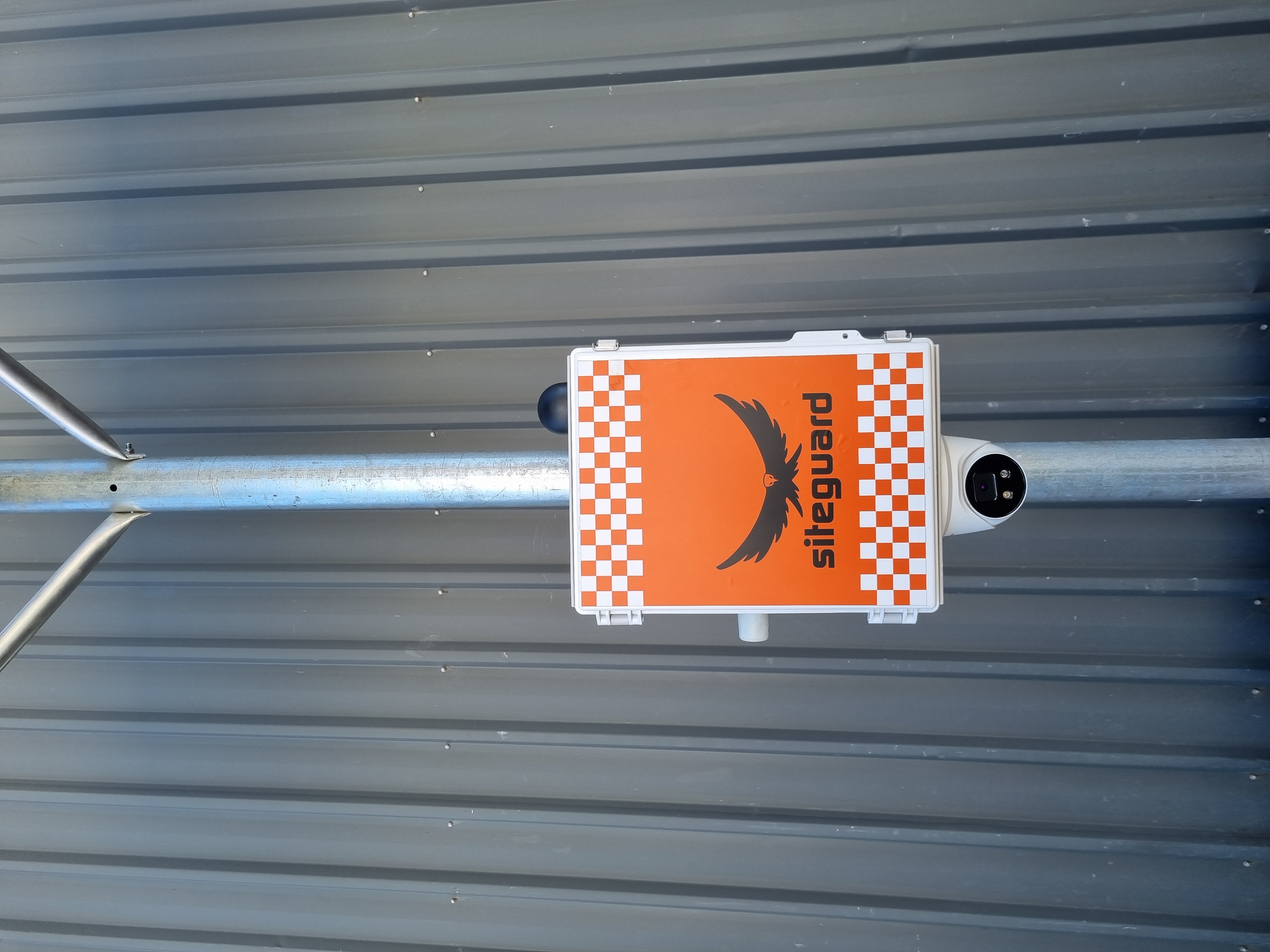
A compact 4G security camera with a built-in panel is the cheapest way to watch a single point, like a pump shed or back gate. For a low-risk spot with strong signal at that exact pole, it can be enough.
The limits show up fast on a real job. The small battery rarely runs sirens or strobes, a unit on a fence post is easy to cut down, and alerts usually go to one phone, so nobody intervenes while a thief is still inside the fence.
If the job is spotting people after dark without tipping them off, a covert unit does it better. Siteguard's Ghost Cams use low-light and thermal imaging to capture clear footage in near-total darkness with no visible flash. They're solar powered, sit in a covert low-profile housing and send instant motion alerts.
Once a site holds something worth stealing, a tower is the step up. Siteguard's solar CCTV towers put the panel, battery and cameras on one engineered base, with no trenching or cabling. Four configurations cover most positions:
The big difference is active deterrence: a siren and strobe on the boundary gives an intruder a reason to leave before they reach the diesel tank. Towers still move when the work does. Michael, Construction Manager at Tamworth Regional Council, put it this way: "We run 6 construction teams and we can easily relocate the system between teams as required, without the need for specialist staff to pack up transport and set up."
Four towers. One platform.
Compare the Single Cam, Twin Cam, Pan & Zoom 360° and Custom towers, available to hire or purchase and built for rapid deployment.
See the tower rangeLinear jobs like pipelines, roads and rail shift every few weeks, and a fixed tower turns every shift into a planned move. Siteguard's solar CCTV trailers are road-certified and self-contained, with solar power, remote WiFi, GPS, UHF radio, 3G/4G, a steel chassis and a weather station. Options include Starlink connectivity, lighting and custom camera setups, so coverage follows the crew. For the full head-to-head, see our CCTV tower vs trailer comparison.
Signal is the other problem. A federal ministerial release puts the area of Australia without mobile coverage at around 70 per cent of the land mass, so on many remote jobs a 4G camera has nothing to talk to. The Siteguard Starlink Tower is built for those sites: fully engineered and wind rated, with a vandal-resistant base and solar panel mounting points.
Satellite costs power, though. Starlink's own Standard kit specification sheet lists average consumption of 75 to 100 W, around the clock. A Starlink unit needs properly sized solar and battery, not a small camera with a dish bolted on.
Start with the site, not the catalogue:
That last question decides how much the hardware is worth. With Control Room Monitoring, Siteguard's Australian-based operators watch your cameras 24/7, including weekends and public holidays. Every alarm is verified by a real operator before they issue audio warnings, trigger the siren or escalate to the relevant authorities.
Surveillance and privacy rules vary between states and territories, and audio recording is treated more strictly than video in several of them. Put signage at site entries and check the rules for the state your site is in.
Siteguard's solar security cameras cover every option here apart from the small 4G camera, so you can mix units across one site.
No. Off-grid cameras send alerts and live view over a 4G modem or a satellite link such as Starlink, so they don't need Wi-Fi on site.
Yes, if it uses satellite. A Starlink-connected tower carries live view and real-time alerts where 3G and 4G don't reach. A 4G-only camera with no signal can still record on board, but it can't alert anyone until the footage is checked.
A small 4G camera covers one point and sends clips to a phone. A solar camera tower carries a larger panel and battery, several cameras or a PTZ, and deterrents like sirens and strobes, and it can be linked to a monitored control room.
Yes. Footage records to storage on the unit, so a dropout doesn't stop recording. Siteguard's Single Cam, for example, lists 30-day storage. Live view and alerts pick up again when the connection returns.
Yes. Siteguard's solar camera towers are available to hire or purchase. Hire suits a single project or a seasonal risk like the Christmas shutdown.
