

The vehicles you most want on record don't turn up at 10am. They roll through an unlit gate at 2am, often with a muddy plate. So the real test for number plate recognition at night is whether the camera can capture a readable plate using only the light it brings.
It can, when three things are right: infrared lighting, shutter speed and plate angle. Here's how each one works, and what a night log looks like at a dark site gate.
Yes. Number plate recognition at night works when the camera has its own infrared or built-in lighting, a fast shutter that freezes the plate, and a square-on view of the lane. Set up that way, a dark site gate still logs every vehicle with a plate, time, date and photo.
Daylight does a camera's work for free. After dark, what's left works against you: headlights aimed at the lens, a plate sitting in shadow under a bull bar, and vehicles that don't slow down because nobody is standing at the gate.
A standard CCTV camera copes with low light by slowing its shutter to soak up more light. That's fine for watching a fence line. It's the wrong setting for reading six characters on a moving ute. As our guide to ANPR technology explains, every read starts with the capture. No sharp, evenly lit plate, nothing to read.
Infrared (IR) light is invisible to people but visible to a camera sensor. A night-capable ANPR camera carries its own IR illuminator aimed at the lane, so it doesn't rely on street lights, floodlights or the vehicle's headlights. Plates with a reflective face bounce that light back towards the lens, so the characters stand out against a darker vehicle.
That lets the camera work on a pitch-black gate, common on regional jobs. IR images are usually black and white, so you get the plate clearly but less detail on vehicle colour. Faded, dirty or half-hidden plates return less light, and those reads fail first.
Siteguard's number plate recognition unit pairs advanced night vision with built-in lighting for low-light detection, and holds sharp HD image quality even in very low light.
Leaving a dark gate behind at knock-off?
See how Siteguard sets up cameras, monitoring and reporting for construction sites, from the moment your crew leaves to the moment they return.
Siteguard for construction
Shutter speed is how long the sensor collects light for each frame. A longer exposure gathers more light, which is why ordinary cameras slow down at night. The catch is motion blur. A vehicle keeps moving while the shutter is open, and the characters smear across the frame.
ANPR cameras keep a fast shutter and add light instead of waiting for it, so the plate freezes in a short exposure. That short exposure also limits headlight glare, because headlights have less time to flood the sensor.
A perfect night image still fails at the wrong angle. From the side, characters squash together. From steeply above, they stretch. Either way the software guesses, and guesses become missed reads.
Mount the camera where vehicles slow and line up, close to square-on with the lane, at a height that clears the bull bar without looking steeply down. The UK's national ANPR standards for policing note that performance targets are easiest to meet with vehicles travelling towards the camera. At night those vehicles bring headlights, so IR and a fast shutter matter most for front plates, and rear reads on exit make a useful backup.
| Night problem | What the log shows | What fixes it |
|---|---|---|
| No site lighting | Dark frames, dim plates | A camera with its own IR or built-in lighting |
| Headlights into the lens | Flare where the plate should be | Fast shutter with IR; read rear plates on exit |
| Vehicle speed | Smeared characters | Read at a gate or chokepoint |
| Steep side angle | Squashed or partial plates | Mount close in line with the lane |
Want plates read at your gate, day or night?
Siteguard's solar-powered ANPR unit captures every vehicle in and out, with night vision, built-in lighting, instant alerts and a searchable vehicle database.
See Siteguard ANPRSet up properly, a night read logs the same as a day read: plate text, time, date and a photo. Siteguard's unit time-stamps every vehicle in and out, and sends an instant alert the moment one arrives. An unknown plate at 2am shouldn't wait for Monday.
Pair that alert with 24/7 control room monitoring and an Australian-based operator verifies the event, issues audio warnings and escalates to the relevant authorities when required. For allow lists and gate hardware, see ANPR site access control.
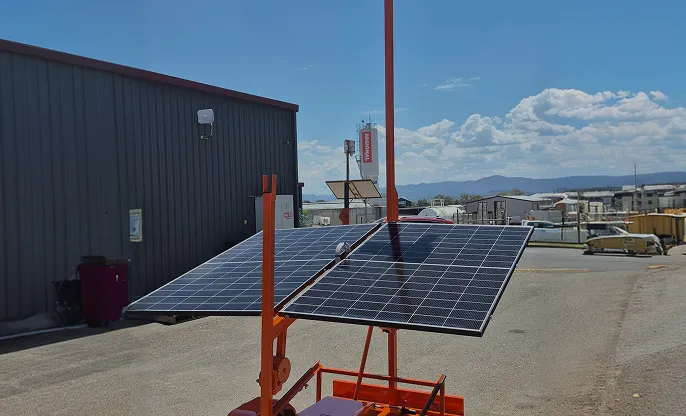
Most dark gates have no power either. Siteguard's ANPR is solar-powered and weatherproof, with no cabling or mains power, on highly visible towers that act as a deterrent. Add solar camera towers for the perimeter, and see our guide to remote site security for sites with no power or internet.
Don't judge a camera on a daytime demo. The same UK standards call for testing in daylight and night-time conditions, over at least 250 consecutive vehicles. The principle holds on a site gate:
Whatever it missed tells you what to fix: angle, height, speed or plate condition. For a full gate setup on an active build, see number plate recognition on construction sites.
Yes, if the camera has its own infrared or built-in lighting, so it lights the plate itself. Siteguard's unit pairs advanced night vision with built-in lighting for low-light detection.
Most general CCTV cameras slow their shutter in low light to gather more light, so moving vehicles blur. ANPR cameras keep a fast shutter and add their own light, which freezes the plate and limits headlight glare.
Headlights aimed at the lens can wash out a front plate on a standard camera. An ANPR camera with infrared and a fast shutter handles glare much better, and a rear-plate read on exit gives a second chance.
Yes. Siteguard's number plate recognition is solar-powered and weatherproof, running off-grid with no cabling or mains power, so it suits dark, unpowered site gates.